

تیرے بِنا
About this song
- Singers
- A.R. Rahman, Chinmayi
- Lyrics
- Gulzar
- Music
- A.R. Rahman
- On screen
- Aishwarya Rai, Abishek Bachchan
- Film
- Guru (movie) (2007)
tere binaa (Hindi: तेरे बिना, Urdu: تیرے بِنا) "Without You", is a song from the 2007 Indian drama film "Guru".
The film appears to be inspired in the life of a number of Indian industrial tycoons, especially Dhirubhai Ambani. "Guru" is short for Gurukant, the name of the main character (played by the Indian actor and producer Abhishek Bachchan).
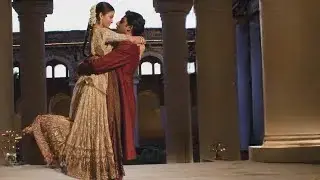
The video clip shows scenes from the movie, where Guru has moments of marital happiness with the wife Sujata (interpreted by the Indian actress Aishwarya Rai who also happens to be his wife in real life).
Later scenes start showing how they grow estranged, because of the pressures of his work, and they finally become reconciled in an embrace.
At the humming parts of this song, the words "dam" and "mast" are used in combination; they do have meaning ("dam" means "breath") and ("mast" means a sense of intoxication in a prosaic or mystical sense, or a general positive adjective in everyday speech). In the song, they are used in a typical way to create a certain beat, independently of their meaning.
Other parts of the song also resort to the names of the classical Indian scale notes for humming (Sa, Re, Ga, Ma, ... etc), which is also typical. Those parts are not reflected in the lyrics, for brevity.
The month of Sawan (saavan) is a traditional Hindu month corresponding to the beginning of the rain season, and as such, associated with feelings of love, joy, and abundance in Hindustani poetry.
The song is said to have been dedicated to the memory of the Pakistani qawwali singer Ustad Nusrat Fateh Ali Khan, at the 10th anniversary of his death, which occurred in 1997.
The lyrics were written by the Indian film director, lyricist, and poet Gulzar (Sampooran Singh Kalra), and the music was composed by the famous Indian composer A.R. Rahman.
Rahman makes abundant use of the idiomatic verb construction kaaTe na kaTe, an expression that means that time (or the night, in this case) passes with difficulty or doesn't pass at all. Lovers staying awake and the night refusing to pass are dominant themes in Hindustani poetry.
The singers are Rahman himself for the male parts, (along with Murtuza Khan, Quadir Khan for the refrains), and the Indian playback singer Chinmayi for the female parts.