

چَل دِیے بندہ نواز
About this song
- Singers
- Mohammed Rafi, Geeta Dutt
- Lyrics
- Majrooh Sultanpuri
- Music
- O.P. Nayyar
- On screen
- Guru Dutt, Madhubala
- Film
- Mr. and Mrs. '55 (1955)
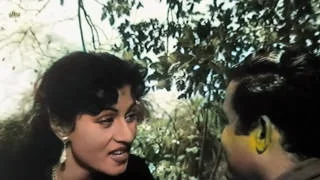
chal die baNdaa navaaz (Hindi: चल दिए बंदा नवाज़, Urdu: چل دیئے بندہ نواز) "The Beneficient One Leaves" is a song from the 1955 Indian film "Mr. and Mrs. '55".
The song's lyrics were written by the Urdu poet and Bollywood lyricist Majrooh Sultanpuri, and the music was composed by the Indian music director and composer O.P.Nayyar.
Both very famous Bollywood contributors, they also authored all the other songs in the movie soundtrack.
The song describes a man pledging his love to a woman, and how she rejects his advances.
In the movie and video clip, the song is played when the main male character, Pritam (interpreted by the actor and director Guru Dutt), declares to Anita, a rich heiress played by the Indian actress Madhubala.
At that moment they are married by convenience, so that Anita could inherit, but Pritam wants the relationship to be true. So he takes her to a riverbank where some washers are beating clothes, and then the song takes place when he starts pleading his love.
She rejects him in amusing ways:
he calls him misTar chaalbaaz, which could be translated as "Mr. Bamboozler" or "Mr. Trickster" he warns him not to become a tiir aNdaaz, meaning an archer or "arrow-shooter" because of his "throwing his heart" at her. tiir aNdaaz is also a common way to refer to someone who achieves goals through skill he tells him to mind his auqaat (status, station in life) because at the time he is just a struggling cartoonist while she is a rich heiress he tells him to "let go of her daaman". "Daman" is a word with rich meanings in Hindustani. Essentially, it is a piece of cloth (and indeed, in the movie, he is holding her headscarf). But a daman is also a skirt or, more properly, the lap, or hem, or lower part of a dress or tunic, such of those worn in olden times. A beggar or solicitor would tug at the lord's daman, in order to call his attention. And then he would fill his own daman, using it as a bag or pocket for whatever alms he received. Idiomatically then, "let go of my daman" means "leave me alone, go away, stop pestering or petitioning" She calls him Sir Manjun (majnuuN miyaaN), who is the male character of a tragic Arabic love story, "Laila and Manjun", also well-known in Persia and in the Indian subcontinent. So this would be equivalent to "Mr. Romeo". She advises him to "take the road of the jungle". This can refer again to Manjun, who, love-crazed, goes to live in the jungle in the "Laila and Manjun" story, or it might simply refer to the Hindu tradition of giving up passions and going to the jungle to meditate in the later stages of life.
As for Pritam:
he constantly calls her, somewhat sarcastically, baNdaa navaaz, an adjectival phrase also used in the song's title, which literally means "comforter of the servant", but can also mean simply "beneficient" or "the beneficient one" (a title also applied to some Muslim saints). he says that "she stirs the string or his heart", a common analogy between the heart and a musical instrument, specifically an iktar or iktara (some sort of single-stringed folk violin) when reminded to mind his lower status, he calls her huzuur a gender-neutral appellation meaning Your Higness, Excellency he calls her saNg-dil which means stone-hearted, hard-hearted
The playback singers are the enormously famous Bollywood singers Mohammed Rafi for the male parts, and Geeta Dutt for the female parts. Geeta Dutt was also the wife of Guru Dutt, the movie protagonist and director.