

ye mard baRe dil sard
About this song
- Singers
- Mohammed Rafi, Lata Mangeshkar
- Lyrics
- Rajendra Krishan
- Music
- Hemant Kumar
- On screen
- Meena Kumari, Gemini Ganesan, Jamuna, Om Prakash
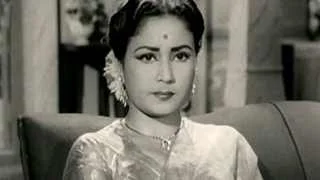
ye mard baRe dil sard (Hindi: ये मर्द बड़े दिल सर्द, Urdu: یہ مَرَد بڑے دِل سرد) is a song from the 1957 Bollywood romantic comedy "Miss Mary".
The film is about a women and a man ("Miss Mary", interpreted by Meena Kumari, and Arun, interpreted by Gemini Ganesan), who apply for a job at a school that requires applicants to be married.
They pretend to be married to each other in order to get the job, despite initially disliking each other.
The video clip shows the scene of the movies where Miss Mary plays the piano and sings a song preventing women against the general wickedness of men, to the annoyance of Arun.
Later, it is Arun who takes the piano and sings, replying that, even if that supposed wickedness were true, that is how the world works, annoying Miss Mary in return.
The female and male song versions have the same setting and actors, but they are not played consecutively in the movie. In the video clip, both songs are collated together.
The song is played in front of Nakdau (Om Prakash) a servant they hire to keep up the pretense, and in front of Sita (Jamuna), the daughter of the school's owners, who dances to the tune.
Sita is also taking a liking for Arun, which annoys Miss Mary even more.
All the film songs' lyrics were written by Rajendra Krishan, and all the music score was composed by Hemant Kumar.
The song uses a couple of idiomatic expressions, such as:
chhoTa mumNh aur baat baRii Small mouth and big word
Which is an expression used to diminish or relativize someone's opinion, because someone is talking without knowing the subject or outside of his area of expertise, or above his station, etc.
It can also be used to introduce or relativize one's own opinion, similar to ""In my humble opinion ..."
Another expression used is uunchii dukaan (literally "high store")
dete haiN maal khoTaa uunchii dukaan vaale The high-shop ones deliver fake goods.
The uumnchii dukaan vaale are the high-shop ones, the "high gentry".
There is also a known Hindustani saying:
uumnchii dukaan phiikaa pakvaan Lofty shop, washed up dish
Finally, there is the expression pate kii baat kahnaa, also sometimes simply pate kii kɛhnaa, which means revealing, disclosing, especially a main point or an important detail (the pate kii baat).
It is used in the following stanzas:
baat pate kii hai ye maano jo meraa kahnaa acchaa hai aag se to duur hii duur rɛhnaa Accept what I am revealing
It is good to stay away from fire
baat pate kii kɛhtaa huuN tum chaahe kaho diivaanaa mardoN kaa phir bhii Gulaam hai zamaanaa I reveal it to you, call it crazy if you want.
Still, this time and age are servants of men.
Miss Mary's female part is sung by Lata Mangeshkar, and Arun's male answer is sung by Mohammed Rafi.