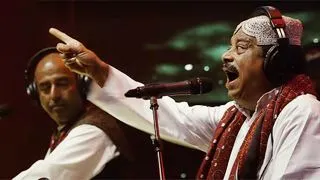
piyaa ghar aayaa
Touch on each word to display its meaning
xvaajaa Gulaam fariid farmaate haiN :
yaar binaa maiN
yaar binaa meNDha jiivan kuuRh e
at andar dard hazaaraaN
yaar binaa
sohne yaar binaa
meNDhe yaar binaa
meNDhe yaar
yaar binaa meraa jiivan kuuRh hai [ x2 ]
at andar dard hazaaraaN
yaar fariidaa ( aahaa )
yaar fariidaa , maiN eNj kuR laavaaN
jivaiN bichhRaaN kuuNj qataaraaN
The Master Ghulam Farid has proclaimed:
"Without the beloved,
without the beloved, life is bitter;
and inside, a thousand pains."
"Without the beloved,
without the beautiful beloved,
without my beloved,
without my Beloved,
without the beloved, life is bitter.
And inside, a thousand pains."
Dear Farid, (¡aha!)
Dear Farid, I will carve my own path,
like separate lines of migrating cranes.
aur bulleh shaah farmaate haiN :
meraa piyaa ghar aayaa
ho laal nii meraa piyaa ghar aayaa [ x3 ]
ho
piyaa ghar aayaa saanuuN allaah milaayaa [ x2 ]
hun aape kardaa nihaal nii
meraa piyaa ghar aayaa saanuuN allaah milaayaa
meraa piyaa ghar aayaa
And Bulleh Shah has proclaimed:
My beloved came home,
oh my little rosy one!, my beloved came home. [x3]
Oh,
The Beloved came, Allah has united us! [x2]
Now He makes me happy.
My beloved came, Allah has united us!
My beloved came home.
ho vo meNDha piyaa
meNDha piyaa
meNDha piyaa
ai aamadanaish
ai aamadanaish ba'ise aabaadii-e-maauu
meraa piyaa ghar aayaa [ x3 ]
meraa piyaa
aao nii saiyyoN [ x3 ]
mainuuN dayo badhaaii
meraa piyaa ghar aayaa
ho laal nii meraa piyaa ghar aayaa
Oh, he is my beloved,
my beloved,
my beloved.
Ah, his arrival…
His joyful arrival at this my house…
My beloved came home. [x3]
My beloved…
Come, oh dear ones, [x3]
give me congratulations:
My beloved came home,
oh my little rosy one, my beloved came home!
ho , vo aate haiN ( aahaa )
vo aaeNge
haa
vo aate haiN
vo aaeNge
vo aane ko haiN
vo aae
[ the 3 lines x2 ]
Oh, he is coming (¡ah!)
he will come,
Ha!
He comes.
He will come.
He is about to arrive.
He came.
[the 3 lines x2]
o bulleh shaah farmaate haiN ( aahaa ):
us rab nuuN manaanaa okhaa nahiiN [ x6 ]
do nafal paRho rab man jaandaa [ x2 ]
us rab nuuN manaanaa okhaa nahiiN [ x4 ]
mere rab ko manaanaa to bahut aasaaN hai
us ke Huzuur meN do rakat nafal pesh kar do
vo man jaataa hai
are bhaaii nafil to bahut baRii baat hai
nafil kii naqal hii kar lo
ho
meraa piyaa ghar aayaa [ x2 ]
"Oh," declares Bulleh Shah (¡aha!):
"To please that God is not difficult." [x6]
"Pray two nafil, and God is pleased." [x2]
"To please that God is not difficult." [x4]
Pleasing my Lord is very simple;
in His presence, offer two brief prayers,
and He is pleased.
Oh brother!, even the optional prayers are too much:
just imitate the act of praying.
Oh…
my beloved came home. [x2]
us rab nuuN manaanaa okhaa nahiiN [ x4 ]
do nafal paRho rab man jaandaa [ x4 ]
je yaar kise daa rus jaave [ x4 ]
nach nach ke manaanaa paindaa e
meraa piyaa ghar aayaa [ x2 ]
je yaar kise daa rus jaave [ x4 ]
nach nach ke manaanaa paindaa e
meraa piyaa ghar aayaa [ x2 ]
[ last 3 lines x2 ]
To please that Lord is not difficult. [x4]
Pray two nafil, and the Lord is pleased. [x4]
If the beloved becomes angry with someone, [x4]
you must appease him by dancing.
My beloved came home. [x2]
If the beloved becomes angry with someone, [x4]
you must appease him by dancing.
My beloved came home. [x2]
[the last 3 lines x2]
farmaate haiN :
o ,
ki Haal sunaavaaN ( haaai haaai haaai )
ki Haal sunaavaaN ( aahaa ) dil daa ve
( hai ) koii meHram raaz naa mildaa
[ last 2 lines x2 ]
o
raanjhan raanjhan kuuk phirii mainuuN raanjhNRaa milyaa nahiiN [ x4 ]
rab milyaa je mainuuN raaNjhaa je naa milyaa
rab , raaNjhe jer dii naa takko
meraa piyaa ghar aayaa [ x2 ]
He proclaimed:
"Oh,
So that I can my state (¡ay, ay, ay!)…
So that I can tell the state of my heart (¡ah!)…
My secret has found no confidant."
[the last 2 lines x2]
Oh,
I wandered crying "Ranjha, Ranjha!" but did not find Ranjha. [x4]
If I did not find Ranjha, I found the Lord.
Lord, do not attempt to link me with Ranjha anymore.
My beloved came home. [x2]
o
paRh paRh ilm kitaabaaN vaalaa naam rakhayo qaazii [ x3 ]
o
makke jaa kar haj paRh aayo naam rakhayo haajii [ x2 ]
phaR shamshiir mujaahidaaN vaalii naam rakhayo Gaazii [ x2 ]
ho
bulleh shaah ne kujh naiiN kitaa [ x3 ]
yaar nuuN kitaa raazii
meraa piyaa ghar aayaa [ x2 ]
Oh,
From reading and studying scholarly texts, they call you "qazi" (judge). [x3]
Oh,
Having gone to Mecca and performed the "hajj", they call you pilgrim. [x2]
Having wielded the sword of holy warriors, they call you "conqueror". [x2]
Oh.
Bulleh Shah did none of that. [x3]
He only pleased the beloved.
My beloved came home. [x2]
ho meraa [ x3 ]
piyaa piyaa piyaa piyaa [ x4 ]
Oh, my… [x3]
beloved, beloved, beloved, beloved. [x4]
paRh paRh aalim faazil hoyaa
kade apne aap nuuN paRhayaa nahiiN
jaa jaa vaRdaa [ x2 ]
mandar masiitaaN oe
kade man apne vich vaRyaa naiiN
aivaaiN roz shaitaan naal laRadaa [ x2 ]
kade nafs apne koloN laRayaa nahiiN
ve bulleyaa aasmaaniyaaN uRdiyaaN phaRdaa [ x2 ]
jeRaa ghar baiThaa onuuN phaRiyaa nahiiN
o
meraa piyaa ghar aayaa [ x2 ]
From so much reading, he became a notable scholar,
but he never read himself.
Going again and again
to temples and mosques,
he never penetrated his own heart.
Daily he fought in vain with Satan,
never fought his own carnal ego.
Oh, Bulleh, you catch what flies in the sky,
but you do not seize the one sitting at home.
Oh…
My beloved came home. [x2]
o tavjjo kaa taalib huuN
dekhii jeye kis taraH buzurgoN ne
majaaz ke ruup meN Haqiiqat ko samjhaayaa hai
farmaate haiN :
majnuuN nuuN ral aashiq kɛhinde
majnuuN se tamaam aashiqoN ne mil kar kahaa
aashiq , yaanii , profeshnal aashiq vo bhii
majnuuN nuuN ral aashiq kɛhinde
ki kɛhinde ?
ve terii lailaa rang dii kalii
majnuuN nuuN ral aashiq kɛhinde ve ( ki ?)
terii lailaa rang dii kalii ( jaa jaa ) [ x4 ]
[ last 3 lines x2 ]
Oh, I seek your attention:
see how the ancients
explained reality through metaphors:
They declare:
To Majnun, the gathered lovers call him…
The lovers, having gathered, say to him:
(the lovers, that is, even professional lovers),
The lovers say to Majnun …
What do they say?
"Eh, the color of your Laila is dark!"
The lovers, gathered, say to Majnun … (what?)
"The color of your Laila is dark" (go, go). [x4]
[the last 3 lines x2]
ditaa javaab majnuuN miyaaN ?
majnuuN ko sab mil ke paagal samjhte haiN
aur akelaa majnuuN sab ko paagal samjhtaa hai
kɛhtaa hai
kitaa javaab majnuuN miyaaN
vo jaa terii ax nahiiN vekhaNR vaalii
ab daliil kyaa detaa hai
quraan kariim de varaq ne chiTTe [ x2 ]
utte likhii e syaahii kalii
ve bulleyaa jithe dil aR jaave [ x2 ]
pher ki gorii ki kalii ve
meraa piyaa ghar aayaa [ x3 ]
And what answer did Mister Majnun give?
(all the gathered consider Majnun mad
and Majnun alone considers everyone mad)
He says,
Mister Majnun responds:
“Go, your eyes no longer know how to see.”
And now, what argument does he give?
“The pages of the Noble Quran are white, [x2]
upon them is written black ink.”
Oh Bulleh, where the heart is stubborn, [x2]
what problem is there with white or black?
My beloved came home. [x3]
ghaRii ghaRii ghaRiyaal bajaave [ x2 ]
raat vasal dii payaaN ghaTaave [ x2 ]
mere dil dii baat je paaveN [ x2 ]
haathoN jaa suTo ghaRiyaal nii !
meraa piyaa ghar aayaa [ x10 ]
Again and again the gong marks the hour [x2]
and the night of union shortens. [x2]
If I paid attention to what my heart says [x2]
Ah, I would quiet that gong with my own hands!
My beloved came home. [x10]
About this song
piyaa ghar aayaa (Hindi: पिया घर आया, Urdu: پِیا گھر آیا) — “The Beloved Came Home”, also known as “meraa piyaa ghar aayaa” (“My Beloved Came Home”) — is a song inspired by a famous kalaam (devotional poem) by the 18th-century Sufi poet and mystic Bulleh Shah.
Written in a mixture of languages including Hindustani, Punjabi, and Saraiki, it was performed in 2018 during Season 11, Episode 3 of the Pakistani musical series Coke Studio, in a powerful qawwali rendition by Fareed Ayaz & Brothers and Abu Muhammad.
The piece belongs to the centuries-old Qawwal Bachon ka Gharana tradition, known for its intricate vocal improvisations and rhythmic dialogue between lead and chorus. The lyrics celebrate the ecstatic return of the piyaa (“beloved”), an image that, while couched in mystical language, carries an evident homoerotic and devotional undertone, typical of much Sufi poetry — where divine love is expressed through the language of human longing and union.