

laalchii gvaalaa
Touch on each word to display its meaning
laalchii gvaalaa
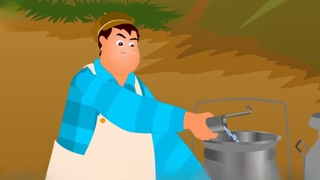
The Greedy Milkman
ek vaqt kaa qissaa hai
ki ek chhoTe se gaaNv meN
henrii aur us kii biivii gloriyaa rɛhtii thii .
henrii gvaalaa thaa .
Once upon a time
in a small village
lived Henry and his wife Gloria.
Henry was a milkman.
miyaaN biivii donoN mil kar gaushaalaa ke maalik the .
ye joRaa apnii gaayoN kaa bahut achchhii se xayaal rakhtaa thaa .
vo unheN achchhaa ghaas dete aur achchhii Gizaa dete .
is vajah se , henrii kii gaaɛN bahut umdaa qism kaa duudh detiiN .
Husband and wife owned a cowshed.
The couple took very good care of their cows.
They gave them good pasture and good food.
That is why Henry’s cows gave milk of excellent quality.
gaaNv meN har koii bas henrii se hii duudh xariidtaa .
henrii aur gloriyaa achchhii kamaaii kar lete
aur un kii achchhii guzar-basar hotii .
par is sab ke baavjuud henrii xush nahiiN thaa .
vo hameshaa baRii kaar aur mɛhɛNge kapRe xariidne ke xaab dekhtaa .
In the village, everyone bought only from Henry.
Henry and Gloria earned well
and lived comfortably.
But, despite all that, Henry was not happy.
He always dreamed of buying a big car and expensive clothes.
" maiN ne apne gaaNv ke baahar ke ilaaqe meN
ek bahut baRaa ghar dekhaa hai .
hameN use xariidnaa chaahie ,
ham bahut hii mɛhɛNgii kaar xariid sakte haiN
aur xidmat ke lie bahut se xaadim rakh sakte haiN .
ham sab se mɛhɛNge libaas pɛhneNge
aur ye sab Gariib gaaNv vaale ham se Hasrat rakheNge ."
"I saw a big house
on the outskirts of the village.
We should buy it,
we can buy an expensive car
and hire many servants for the household.
We will wear the most expensive clothes
and all these poor villagers will envy us."
" ye laalach tumhaare lie achchhaa nahiiN rahegaa .
hamaare paas kaafii hai
aur hameN usii meN xush rɛhnaa chaahie jo hamaare paas hai ."
"That greed will bring you nothing good.
We have enough
and we should be happy with what we have."
" tum is chhoTe se ghar meN kaise xush rɛh saktii ho ?
aur is gaushaalaa meN ?
argh !
in gaayoN kii badbuu naaqaabil-e-bardaasht hai ."
"How can you be happy in this little house?
And in this cowshed?
Argh!
The smell of these cows is unbearable."
" par yahii hamaaraa rozgaar hai !"
" zyaadaa der nahiiN rahegaa .
yaqiin merii baat sach niklegii :
kisii din maiN is shɛhɛr kaa sab se daulatmand iNsaan banuuNgaa ."
" aah !"
"But this is our livelihood!"
"Not for long.
Trust me: the day will come
when I will be the richest man in the village."
"Ah!"
har din jab henrii duudh bech de jaataa ,
gaaNv vaale us kii taariif karte :
" henrii , ye duudh itnaa achchhaa aur sehatmand hai !
tum zaruur apnii gaayoN kii achchhii taraH nigahbaanii karte hoge !"
Every day when Henry sold the milk,
the villagers praised him:
"Henry, this milk is so good and healthy!
You surely take good care of your cows."
" haaN , maiN kartaa huuN ,
par ab zyaadaa der nahiiN .
ek baar jab maiN daulatmand ho jaauuN ,
in sab gaayoN ko bech duuNgaa !
mujhe apne ghar meN vo badbuu pasand nahiiN hai ."
"Yes, I do,
but not for much longer.
As soon as I become rich,
I will sell all these cows!
I can’t stand that smell in my house."
" par ye gaaɛN hii to tumhaaraa rozgaar haiN !
tumheN apne kaam ke baare meN shikaayat nahiiN karnii chaahie .
ye jiine meN tumhaarii madad kartaa hai .
maiN aNRDe bechne kaa rozgaar kartaa huuN .
vo bhii badbuudaar kaam hai
par mujhe us se koii etaraaz nahiiN kyuuNki meraa rozgaar hai ."
"But these cows are your livelihood!
You should not complain about your work.
It is what helps you in life.
I make a living selling eggs.
That too is a smelly job
but I have no objection because it is my livelihood."
" xair , xair , xair .
aur phir shaayad aNRDe bechnaa hii tumhaarii taqdiir hai .
merii taqdiir meN aur aham kaam karnaa hai ,
mɛhɛNgii chiizeN xariidnaa ,
aur mɛhɛNge libaas xariidnaa ."
"Well, well, well.
Maybe selling eggs is your destiny.
Mine is to do important work,
to buy expensive things,
and to wear expensive clothes."
" ye laalach tumheN kahiiN kaa nahiiN rakhegaa mere dost .
jitnaa jaldii tum ye samajh lo utnaa hii achchhaa rahegaa ."
" chalo , maiN ne yahaaN kaafii vaqt barbaad kar diyaa .
in badbuudaar aNRDoN kaa kaarobaar tumheN mubaarak ho !
alvidaa !"
"That greed will get you nowhere, my friend.
The sooner you understand it, the better."
"Well, I’ve already wasted enough time here.
Good luck with those smelly eggs.
Goodbye!"
henrii ko jaldii thii aur zyaadaa daulat kamaane kii .
vo aksar daulatmand banne ke raaz talaash kartaa .
" bas itnaa hai ? ye bahut kam hai !
maiN aur zyaadaa duudh kaise bechuuN ?
koii tariiqaa to honaa chaahie !"
Henry was in a hurry and wanted to earn more money.
He often looked for secrets to become rich.
"That’s all? That’s too little!
How am I to sell more milk?
There must be some way!"
merii gaaɛN sab tandurust haiN .
maiN unheN aur zyaadaa duudh dene par majbuur nahiiN kar saktaa .
aur us se baRh kar , ye chhoTaa saa gaaNv hai .
agar mujhe zyaadaa duudh bhii Haasil ho jaae
to bhii ise bechuuN kaise ?"
"My cows are healthy.
I cannot force them to give more milk.
Besides, this is a small village.
Even if I got more milk,
how would I sell it?"
" are haaN !
ek paRos ke gaaNv meN jaa saktaa huuN ,
vahaaN bahut se ghar haiN ! par phir ,
mujhe aur gaaɛN xariidnii paReNgii ,
aur is vaqt us ke lie mere paas kaafii paise nahiiN haiN ."
"Ah, yes!
I can go to the neighboring village,
there are many houses there! But then
I would have to buy more cows,
and right now I don’t have enough money."
" nahiiN , mujhe kuchh karnaa hii hogaa !
maiN ek baRaa ghar xariidnaa chaahtaa huuN !
ab dekhtaa huuN ,
mere paas ek aur gaaɛ xariidne ke lie
munaasib paise nahiiN haiN ,
phir mujhe duudh kii miqdaar bhii baRhaanii hai .
ise kaise sar-anjaam duuN ?"
"No, I must do something!
I want to buy a big house!
Let’s see,
I don’t have enough money
to buy another cow,
but I need to increase the amount of milk.
How do I manage that?"
jab aage baRhaa , vo ek dariyaa ke qariib aayaa .
aaxir , laalach se saraabor , henrii ko ek tarkiib suujhii :
As he walked on, he came near a river.
Finally, overcome by greed, Henry thought of a trick:
" kyuuN na maiN duudh meN thoRaa saa paanii milaa duuN ?
is tarkiib se
mujhe ek aur gaaɛ xariidne kii zaruurat nahiiN paRegii ,
aur saath hii saath
maiN paRos ke gaaNv meN bhii duudh bech sakuuNgaa !
oh ! ye to shaandaar tarkiib hai .
koii bhii is par tavjjo nahiiN degaa
agar maiN duudh meN paanii milaa duuN ."
"Why not add a little water to the milk?
That way
I won’t need to buy another cow,
and at the same time
I can sell milk in the neighboring village.
Oh! it’s a magnificent plan.
No one will notice
if I mix water with the milk."
aur yahii henrii ne kiyaa .
aglii subaH henrii apne duudh ke bartan bharne lagaa ,
par is dafaa us ne unheN aadhaa bharaa aur chalaa gayaa .
aur phir vo dariyaa par rukaa
aur us meN thoRaa paanii milaayaa .
And that is what Henry did.
The next morning he filled his milk cans,
but this time he filled them only halfway and left.
Then he stopped at the river
and there he added some water.
us din hameshaa kii taraH
logoN ne henrii se xushii xushii duudh xariidaa
aur use utnaa hii paisaa diyaa .
paanii milaane kii vajah se
henrii ke paas kaafii zyaadaa duudh bach gayaa thaa ,
jise us ne paRos ke gaaNv meN bechaa .
That day, as always,
people happily bought Henry’s milk
and paid him the same.
Thanks to the water
Henry had much more milk left,
which he sold in the neighboring village.
us raat , henrii bahut xush thaa .
" ye to bahut achchhaa hai !
agar maiN yahii kartaa rahaa
to jald hii maiN daulatmand ban jaauuNgaa !"
That night Henry was very happy.
"This is fantastic!
If I keep doing this
I’ll soon be rich!"
vo sahii thaa .
din guzrte gae
aur henrii pɛhle se zyaadaa daulatmand ban gayaa .
us ne xud ke lie ek kaar xariidii
aur apne ghar ko sajaayaa sanvaaraa .
And so it was.
Days passed
and Henry became richer than before.
He bought himself a car
and refurbished his house.
use duudh meN paanii milaane kii itnii aadat ho gaii
ki us ne ek aur gaaɛ xariidne ke baare meN
ek dafaa bhii nahiiN sochaa .
jaise jaise duudh kii maaNg baRhii
vaise hii paanii kii miqdaar bhii baRhii .
ye kaii haftoN tak chaltaa rahaa ,
par phir gaaNv meN guftguu hone lagii ,
us paanii mile duudh kii baabat .
He got so used to mixing water with the milk
that he did not even think
of buying another cow.
And as demand increased
so did the proportion of water.
This went on for several weeks,
but then rumors began to spread in the village
about that watery milk.
sachaaii jaanne kii xvaahish lie
kuchh gaaNv vaale henrii ke ghar ke saamne ikTThe hue .
" kyaa maajraa hai ?"
" henrii , hamaarii kuchh shikaayteN haiN
us duudh ke baabat jo tum bechte ho "
" ye paanii kii taraH lagtaa hai "
Wishing to know the truth
some villagers gathered in front of Henry’s house.
"What’s going on?"
"Henry, we have some complaints
about the milk you sell."
"It tastes like water!"
" kyaa ?
tumhaarii ye kɛhne kii jurrat kaise huii ?"
" ham duudh kii qiimat adaa karte haiN , henrii , paanii kii nahiiN !
ab tum hameN aur bevquuf nahiiN banaa sakte ."
" kuchh bhii badlaa nahiiN hai .
tum sab ko achchhaaii kii qadar hii nahiiN hai .
maiN yaqiinan bahut mashqqat kartaa huuN .
jaao , kahiiN aur se duudh xariido agar tumheN pasand nahiiN !
mujhe tumhaarii zaruurat nahiiN hai .
mere paas kaii aur duusre gaaNv haiN
jinheN ye duudh pasand hai ."
"What?
How dare you say that?"
"We pay for milk, Henry, not for water!
You can’t fool us anymore."
"Nothing has changed.
You don’t know how to appreciate quality.
I work very hard, indeed!
Go buy milk somewhere else if you don’t like it!
I don’t need you.
I have many other villages
that like this milk."
henrii tezii se andar gayaa
aur darvaazaa dhaRaam se baNd kar diyaa .
" kuchh to sahii nahiiN lagtaa "
" maiN razaamand huuN , hameN daryaaft karnaa hogaa "
un sab ne sach kaa pataa lagaane kaa maṁsuubaa banaayaa .
Henry ran inside
and slammed the door shut.
"Something doesn’t add up."
"I agree, we must investigate."
They all planned to uncover the truth.
aglii subaH henrii hameshaa kii taraH
dariyaa kii taraf gayaa .
us ne apne aadhe bhare bartan khole
aur un meN paanii bharaa .
par use is kaa zaraa bhii ilm nahiiN thaa
ki koii use dekh rahaa hai .
The next morning Henry as always
went toward the river.
He opened his half-filled cans
and topped them with water.
But he did not know
that someone was watching him.
" us kii ye jurrat kaise huii ?"
" ye durust nahiiN hai "
" yahii vajah hai ki vo daulatmand bantaa jaa rahaa hai ."
" us kii gaayoN kii taadaad utnii hii hai
aur phir bhii vo itne gharoN ko duudh bech rahaa hai ."
gaaNv vaale puuraa maajraa samajh gae aur unhoN_ne
is laalchii gvaale ko sabaq sikhaane kaa faislaa kiyaa .
"How dare he?"
"This is not right."
"That’s why he is getting rich."
"He has the same number of cows
and yet he sells milk to so many houses."
The villagers understood the whole matter and decided
to teach this greedy milkman a lesson.
agle din gloriyaa baazaar gaii daal xariidne ke lie .
us raat jab henrii kaam se vaapas aayaa ,
vo donoN khaanaa khaane baiThe .
" vo kyaa hai ? kyaa tum ne patthar pakaae haiN ?"
" patthar ? nahiiN , ye daal hai ."
" nahiiN , ye daal nahiiN hai ."
" mujhe is par yaqiin nahiiN ho rahaa !
dukaandaar ne tumheN daal ke saath
chhoTe chhoTe patthar bech diye haiN !
us kii ye jurrat kaise huii ?
maiN jaa kar kal us se mulaaqaat karuuNgaa ."
us raat henrii aur gloriyaa bhuukhe peT soe .
The next day Gloria went to the market to buy lentils.
That night when Henry came back from work,
the two sat down to dinner.
"What is this? Have you cooked stones?"
"Stones? No, these are lentils."
"No, they are not lentils."
"I can’t believe it!
The grocer sold you lentils
with little stones!
How dare he?
I’ll go see him tomorrow."
That night Henry and Gloria went to bed hungry.
agle din Gusse meN henrii us dukaandaar ke paas gayaa .
" tum ne hameN kyaa bechaa ?
ham ne patthroN ke to paise nahiiN diye the ,
ham ne daal ke paise diye the ."
" jaao kahiiN aur se jaa kar xariido .
agar tumheN ye pasand nahiiN , mujhe tumhaarii zaruurat nahiiN ."
henrii Gusse meN ghar vaapas aayaa .
The next day Henry went furiously to the grocer.
"What did you sell us?
We didn’t pay for stones,
we paid for lentils."
"Go buy somewhere else.
If you don’t like it, I don’t need you."
Henry returned home angry.
kuchh der ke baad vo baahar gayaa
ek dukaan se aNRDe xariidne ke lie .
jab vo ghar aayaa aur us ne unheN toRne kii koshish kii ,
to use ye maaluum huaa ki baarah meN se das aNRDe patthar the .
vo baguulaa ho gayaa .
A little later he went out
to buy eggs at a shop.
When he came back and tried to crack them,
he discovered that ten of the twelve were stones.
He flew into a rage.
" tum ne mujhe ye kyaa bechaa ?
ham ne aNRDoN kii qiimat adaa kii thii patthroN kii nahiiN !"
" isii taraH ham ne bhii duudh ke paise diye the
paanii ke nahiiN !"
" jaao kahiiN aur se jaa kar xariido
agar tumheN ye pasand nahiiN .
mujhe tumhaarii zaruurat nahiiN ."
henrii Gusse meN chalaa gayaa .
"What did you sell me?
We paid for eggs, not for stones!"
"And we also paid for milk,
not for water."
"Go buy somewhere else
if you don’t like it.
We don’t need you."
Henry stormed off.
agle din us ne ek reshmii qamiiz xariidii .
us ke ghar aate aate baarish hone lagii .
paanii ne us kii qamiiz kaa saaraa rang dho diyaa .
jab vo ghar pahuNchaa , use ye maaluum huaa
ki qamiiz resham kii nahiiN balki san kii banii hai .
The next day he bought a silk shirt.
On his way home it began to rain.
The water washed out all the color of the shirt.
When he arrived, he discovered
that the shirt was not silk but linen.
ye silsilaa kuchh dinoN tak jaarii rahaa .
har dafaa jab henrii kuchh baahar xariidne gayaa
to ghar aataa kuchh alag hii chiiz lie .
" maiN is se tang aa gaii huuN .
vo hameN sahii chiiz kyuuN nahiiN bechte ?"
" vo hameN bevquuf banaa rahe haiN . ye sahii nahiiN hai "
This continued for some days.
Every time Henry went out to buy something
he came back with something different.
"I’m tired of this.
Why don’t they sell us the right things?"
"They are making fools of us. It’s not right."
henrii apne aur apne laalach ke baare meN sochne meN
itnaa mashGuul thaa
ki use samajh hii nahiiN aayaa
ki us ne yahii chiiz duusroN ke saath bhii kii thii .
kuchh der baad paRosii gaaNv bhii shikaayat karne lage .
aahistaa aahistaa sab ne henrii se duudh xariidnaa baNd kar diyaa .
jab us ke paas xarchaa ke lie koii paisaa na bachaa ,
henrii vo chiizeN bechne lagaa
jo us ne ghaTiyaa darje kaa duudh bech kar xariidii thiiN .
Henry was so absorbed
in thinking about himself and his greed
that he did not realize
he had done the same to others.
Before long the neighboring village also began to complain.
Little by little everyone stopped buying his milk.
When he no longer had money for expenses,
Henry began to sell the things
he had bought by selling adulterated milk.
ab henrii ek Gariib gvaalaa thaa .
us ke paas thoRii sii hii gaaɛN bachii thiiN ,
aur kuchh hii ghar bache the jahaaN vo duudh bech saktaa thaa .
" ab tumheN aql aae kii tum ne kyaa kiyaa ?
tumhaaraa laalach hamaarii Gariibii kii vajah hai .
agar tum ne achchhaa duudh bechnaa jaarii rakhaa hotaa
jaisaa tum bechaa karte the
to kisii din ham bhii ek baRaa saa ghar
aur mɛhɛNge kapRe xariid sakte the .
tumhaare lie bas yahii laazmii thaa
ki sabr rakho aur meHnat karte raho ."
Now Henry was a poor milkman.
He had only a few cows left,
and only a few houses to sell milk to.
"Do you understand now what you did?
Your greed is the cause of our poverty.
If you had kept selling good milk
as you used to,
someday we too could have had a big house
and buy fine clothes.
All that was necessary was that you
had patience and worked hard."
" maiN tum se ittifaaq rakhtaa huuN gloriyaa .
mujhe tumhaarii baat sunnii chaahie thii .
maiN ne apnaa paisaa hii nahiiN khoyaa ,
maiN ne logoN kaa etbaar aur izzat bhii kho dii hai ."
" aah !"
"I agree with you Gloria.
I should have listened to you.
I not only lost my money,
I also lost people’s trust and respect."
"Ah!"
henrii ne duudh bechnaa jaarii rakhaa
aur apnii gaayoN kii nigahbaanii kartaa rahaa .
ab use ilm ho gayaa thaa
ki laalach kitnaa xatarnaak ho saktaa hai .
us ne apnaa sabaq Haasil ho gayaa thaa .
us din ke baad us ne duudh meN kabhii paanii nahiiN milaayaa ,
aur usii meN mutamain rahaa jo vo kamaataa thaa .
Henry went on selling milk
and taking care of his cows.
Now he understood
how dangerous greed can be.
He had learned his lesson.
From that day he never again mixed water with milk,
and was content with what he earned.
About this song
“The Greedy Milkman” (Hindi: लालची ग्वाला, Urdu: لالْچى گْوالا ) is a moralizing children’s story that conveys a simple lesson against greed.
It is mainly circulated through YouTube series such as Spanish Fairy Tales, Urdu Fairy Tales, or Hindi Fairy Tales, where the same story is narrated in different languages with children’s animations.
It is not part of any classic collection of traditional Hindustani tales, but rather presented as a modern story adapted for a young audience. Even so, the theme of punished greed is universal: similar examples can be found in European fables, Arabic stories, or African folk tales. Its main purpose is didactic: to entertain children while teaching them the importance of honesty.