hai bas-ki har ik un ke ishaare
Touch on each word to display its meaning
hai bas-ki har ik un ke ishaare
As in Every Single Gesture of Hers
[ mixed with movie dialog ]
hai bas-ki har ik un ke ishaare meN nishaan aur
karte haiN moHabbatt to guzrtaa hai gumaan aur
[mixed with movie dialog]
As in every single gesture of hers, there are more signals
if she expresses love, then more suspicion occurs
yaa rab vo na samjhe haiN na samjheNge mirii baat [ x2 ]
de aur dil un ko jo na de mujh ko zabaan aur [ x2 ]
Oh God! She has neither understood my words, nor she will [x2]
give her another heart, if you wouldn't give me another language! [x2]
tum shɛhɛr meN ho to hameN kyaa Gam jab uTheNge [ x2 ]
le aaeNge baazaar se jaa kar dil-o-jaan aur [ x2 ]
[ mixed with movie dialog ]
As long as you are in town, then, when my sorrow arises [x2]
I will ultimately bring from the bazaar another heart-and-soul [x2]
[mixed with movie dialog]
haiN aur bhii duniyaa meN suxan-var bahut achchhe [ x2 ]
kɛhte haiN ki Gaalib kaa hai aNdaaz-e-bayaan aur [ x2 ]
[ the full stanza is repeated ]
[ mixed with movie dialog ]
Even (though) there are in the world many other good versifiers
they say that Ghalib's is a different narration style
[the full stanza is repeated]
[mixed with movie dialog]
About this song
- Singer
- Mohammed Rafi
- Lyrics
- Ghalib
- Music
- Ghulam Mohammed
- On screen
- Bharat Bhushan
hai bas-ki har ik un ke ishaare (Hindi: है बस-कि हर इक उन के इशारे, Urdu: ہے بَسْکہِ ہر اِک اُن کے اِشارے), "As Ever Single Gesture of Hers ... " are the opening words of a famous ghazal by the Urdu poet Ghalib.
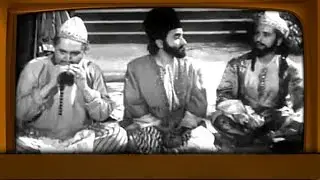
Some couplets of this ghazal were musicalized by Ghulam Mohammed and used in a scene of the biographical 1954 Bollywood movie "Mirza Ghalib".
In the scene, the poet (interpreted by Bharat Bhushan) meets a blind beggar in the street, who is singing this poem of his recent creation.
When asked by Ghalib where he had learned it, the beggar answers that he got it from Moti Begum, Ghalib's most recent female admirer, who by then had adopted the nickname of "Chaudhvin" (Moon Faced) given by the poet to her.
The playback singer was Mohammed Rafi.