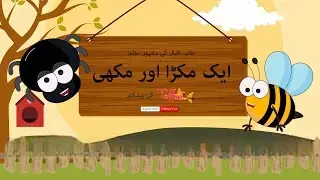
ek makRaa aur makkhii
Touch on each word to display its meaning
ik din kisii makkhii se ye kɛhne lagaa makRaa
is raah se hotaa hai guzar roz tumhaaraa
lekin mirii kuTiyaa kii na jaagii kabhii qismat
bhuule se kabhii tum ne yahaaN paaNv na rakkhaa
One day, to some fly, a spider started telling this:
"Your passing from this path happens daily,
but my hut's fate never rose
(so that) you would perchance set foot here"
GairoN se na milie to koii baat nahiiN hai
apnoN se magar chaahie yuuN khiNch ke na rɛhnaa
aao jo mire ghar meN to izzat hai ye merii
vo saamne siiRhii hai jo manzuur ho aanaa
"Don't meet with strangers, that's not an issue,
but with one's own, it is necessary not to stay withdrawn in such a way"
"Should you come to my house, it would be an honor,
those are the stairs, if you would accept to come"
makkhii ne sunii baat jo makRe kii to bolii
Hazrat kisii naadaan ko diijega ye dhokaa
is jaal meN makkhii kabhii aane kii nahiiN hai
jo aap kii siiRhii pe chaRhaa phir nahiiN utraa
When the fly heard the words of the spider, she said:
"Sir! Try this deception with someone naïve!
In this net, there must never be the coming of a fly!
Whoever went up your stairs, never descended!"
makRe ne kahaa vaah farebii mujhe samjhe
tum saa koii naadaan zamaane meN na hogaa
manzuur tumhaarii mujhe xaatir thii vagrnaa
kuchh faaydaa apnaa to miraa is meN nahiiN thaa
The spider said: "Whoa, you assume I am deceptive?
There couldn't be a naïve one such as you in the world!
I had only intended consideration towards you, otherwise …
there wasn't any benefit for me in this"
uRtii huii aaii ho xudaa jaane kahaaN se
Thahro jo mire ghar meN to hai is meN buraa kyaa
is ghar meN kaii tum ko dikhaane kii haiN chiizeN
baahar se nazar aataa hai chhoTii sii ye kuTiyaa
"You have come flying from God knows where.
Should you pause at my home, what would be the evil in this?
In this house, there are some things to show to you:
From the outside, this hut appears smallish, (but) …"
laTke hue darvaazoN pe baariik haiN parde
diivaaroN ko aaiinoN se hai maiN ne sajaayaa
mehmaanoN ke aaraam ko Haazir haiN bichhaune
har shaxs ko saamaan ye mayssar nahiiN hotaa
" … the curtains hanging on the doors are fine,
the walls, I have arranged with mirrors.
For the comfort of guests, bedding is ready.
This apparatus is not available to every person!"
makkhii ne kahaa xair ye sab Thiik hai lekin
maiN aap ke ghar aauuN ye ummiid na rakhnaa
in narm bichhaunoN se xudaa mujh ko bachaae
so jaae koii in pe to phir uTh nahiiN saktaa
The fly said: "All this is well and good, but
you must not keep this hope that I shall come to your home.
May God protect me from this warm bedding,
on which, whoever goes, can never get up!"
makRe ne kahaa dil meN sunii baat jo us kii
phaaNsuuN ise kis taraH ? ye kam-baxt hai daanaa
sau kaam xushaamad se nikalte haiN jahaan meN
dekho jise duniyaa meN xushaamad kaa hai bandaa
The spider said to himself, when she heard her words:
Which way shall I ensnare her? This retched one is wise!
In the world, a hundred tasks must be accomplished with flattery.
Whoever you might see in the world, is a servant of flattery."
ye soch ke makkhii se kahaa us ne baRii bii
allaah ne baxshaa hai baRaa aap ko rutbaa
hotii hai use aap kii suurat se moHabbatt
ho jis ne kabhii ek nazar aap ko dekhaa
Having thought this, he said to the fly: "Great Miss …
God has granted great status to you!
He falls in love with your face,
whoever has one glance at you!"
aaNkheN haiN ki hiire kii chamktii huii kaniyaaN
sar aap kaa allaah ne kalGii se sajaayaa
ye Husn ye poshaak ye xuubii ye safaaii
phir us pe qayaamat hai ye uRte hue gaanaa
Are (those) eyes or shining diamond dust?
God has adorned your head with a crown!
This beauty, this attire, this quality, this purity!
Then, on top of that, is this singing while flying!
makkhii ne sunii jab ye xushaamad to pasiijii
bolii ki nahiiN aap se mujh ko koii khaTkaa
iNkaar kii aadat ko samjhtii huuN buraa maiN
sach ye hai ki dil toRnaa achchhaa nahiiN hotaa
When the fly heard this flattery, she was moved.
She said: "I have no apprehension towards you"
"I understand the habit of refusal is bad"
"It is true that breaking hearts is not good"
ye baat kahii aur uRii apnii jagah se
paas aaii to makRe ne uchhal kar use pakRaa
bhuukaa thaa kaii roz se ab haath jo aaii
aaraam se ghar baiTh ke makkhii ko uRaayaa
She said this and flew from her place
She came close, the spider jumped and caught her
For some days he had been hungry. Now, as she came within reach,
he sat comfortably at home and ate the fly with gusto
About this song
- Lyrics
- Allama Iqbal
ek makRaa aur makkhii (Hindi: एक मकड़ा और मक्खी, Urdu: ایک مکڑا اَور مَکّھی) "A Spider and a Fly", was a fable written in poem (nazm) form by Allama Iqbal.
The story is about how a spider entices a fly to come closer in order to eat it.
(the word makkhii can also refer to a bee).
The fly is initially reluctant, but it is convinced by the spider through flattery.
It is perhaps important to point out that the word for spider is makRaa, masculine, while the word for fly is makkhii, feminine. Therefore in the poem the spider is referred as to as "he", and the fly as "she".
The fly is initially reluctant, but she is eventually convinced to come closer when the spider starts complimenting her appearance.
In the final stanza, the verb uRaanaa is used to describe what the spider does to the fly.
It might be a play of words as uRaanaa could have multiple meanings there: to make someone fly, to finish someone off, to eat someone with relish, etc.
The poem was part of Iqbal's book "Bang-e-Dara" (The Call of the Marching Bell) published in 1924.
In the accompanying video clip, it is narrated by a girl called Fatimah-Zahra as part of a Youtube channel for kids called "TofeeTV".