Hindustani Songs Logo
DICTIONARY
SONGS
SCRIPT
LATIN
HINDI
NASTALIQ
NASKH
LANGUAGE
ENG
SPA
Menu
Hindustani Songs Logo
DICTIONARY
SONGS

aaiye mehrbaaN

aaiye mehrbaaN
Touch on each word to display its meaning
aaiye   meharbaan
Come, Kind One!
aaiye   meharbaan ,
baiThiye   jaan-e-jaan
shauq   se   liijie   jii ,
ishq   kii   imtHaan
 [ all stanza x2 ]
aaiye   meharbaan  …
Come, kind one!
Sit down, dearest!
Take, Sir, for pleasure,
the test of love
[all stanza x2]
Come, kind one …
kaise   ho   tum   naujvaan ,
itne   Hasiin   mɛhmaan
 [ both lines x2 ]
kaise   karuuN   maiN   bayaan ,
dil   kii   nahiiN   hai   zubaan
 [ both lines x2 ]
What a youth you are,
such a handsome guest!
[both lines x2]
How shall I describe (this)?
(My) heart doesn't have a tongue!
[both lines x2]
aaiye   meharbaan ,
baiThiye   jaan-e-jaan
shauq   se   liijie   jii ,
ishq   kii   imtHaan
aaiye   meharbaan  …
Come, kind one!
Sit down, dearest!
Take, for pleasure,
the test of love
Come, kind one …
dekhaa   machal   ke   jidhar ,
bijlii   giraa   dii   udhar
 [ both lines x2 ]
kis   kaa   jalaa   aashiyaaN ,
bijlii   ko   ye   kyaa   xabar
 [ both lines x2 ]
In view that, after getting restive,
a lightning struck there
[both lines x2]
Whose nest it burnt,
what does the lightning know?
[both lines x2]
aaiye   meharbaan ,
baiThiye   jaan-e-jaan
shauq   se   liijie   jii ,
ishq   kii   imtHaan
 [ all stanza x2 ]
aaiye   meharbaan  …
Come, kind one!
Sit down, dearest!
Take, Sir, for pleasure,
the test of love
[all stanza x2]
Come, kind one …

About this song

Singer
Asha Bhosle
Lyrics
Qamar Jalalabadi
Music
O.P. Nayyar
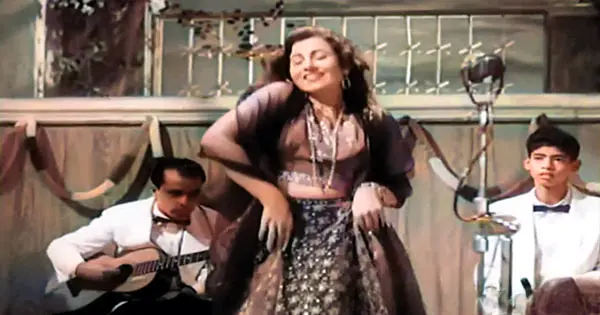
On screen
Madhubala, Ashok Kumar, K.N.Singh, Dhumal

jaa jaa re apne mandirvaa (Hindi: जा जा रे अपने मंदिरवा) "Go, Go to Your Temple, Dear!", is a classical bandish (composition) performed in the raga Bhimpalasi.

The composition was originally created by the legendary court musician Sadarang (Naimat Khan) during the reign of the Mughal emperor Muhammad Shah "Rangila" in the early 18th century (c. 1719–1749).

The lyrics express a lover's playful and affectionate plea, using the metaphor of a "temple" to refer to the beloved's home or heart. The singer alternates between longing, coyness, and gentle reproach, urging the beloved to either leave for their "temple" or stay and reveal their true feelings.

The song is a prime example of the khayal style, which Sadarang himself helped popularize. Its enduring beauty lies in the delicate interplay between the romantic lyrics and the meditative, melancholic tones of raga Bhimpalasi.

In modern times, the piece has been recreated and popularized by various contemporary artists, including a well-known version by Sniti Mishra released in July 2026, which brought this centuries-old classic to a new generation of listeners.